Naples' Flood Map Is Changing This Fall. Your Elevation Certificate Matters More Than Your Zone Letter.
August 27, 2026
August 27, 2026
Picture two homes a few doors apart on the same canal, one in Port Royal, one in Aqualane Shores. Same flood zone designation on the county map. Same general exposure to the Gulf. When each owner runs a flood insurance quote this month, the numbers come back thousands of dollars apart.
That's not a fluke. It's how flood insurance actually works in 2026, and it's the piece of the puzzle a lot of Naples waterfront sellers still don't have their arms around, right as the county prepares to redraw the map underneath them.
Start with what's actually true today. As of July 20, 2026, the flood insurance rate map governing Collier County is still the one adopted on February 8, 2024. The county's 2026 Physical Map Revision, the update that will eventually reset flood zone boundaries and Base Flood Elevations across the coastline, is projected for adoption sometime between August and October 2026, and that timeline still depends on federal review and appeal windows.
In other words: nothing has flipped yet. But preliminary maps are already public, and buyers, lenders, and insurers who know how to read them are using that information right now to size up risk on properties they're considering. If you're listing a waterfront home in Naples this fall, the version of the map your buyer's team is quietly checking may not be the one on file at City Hall.
For years, the shorthand was simple: Zone X is safe, Zone AE means mandatory insurance and a real cost, Zone VE means the coastal high-hazard tier and the biggest premiums. That shorthand isn't wrong, exactly, but it's incomplete in a way that catches sellers off guard.
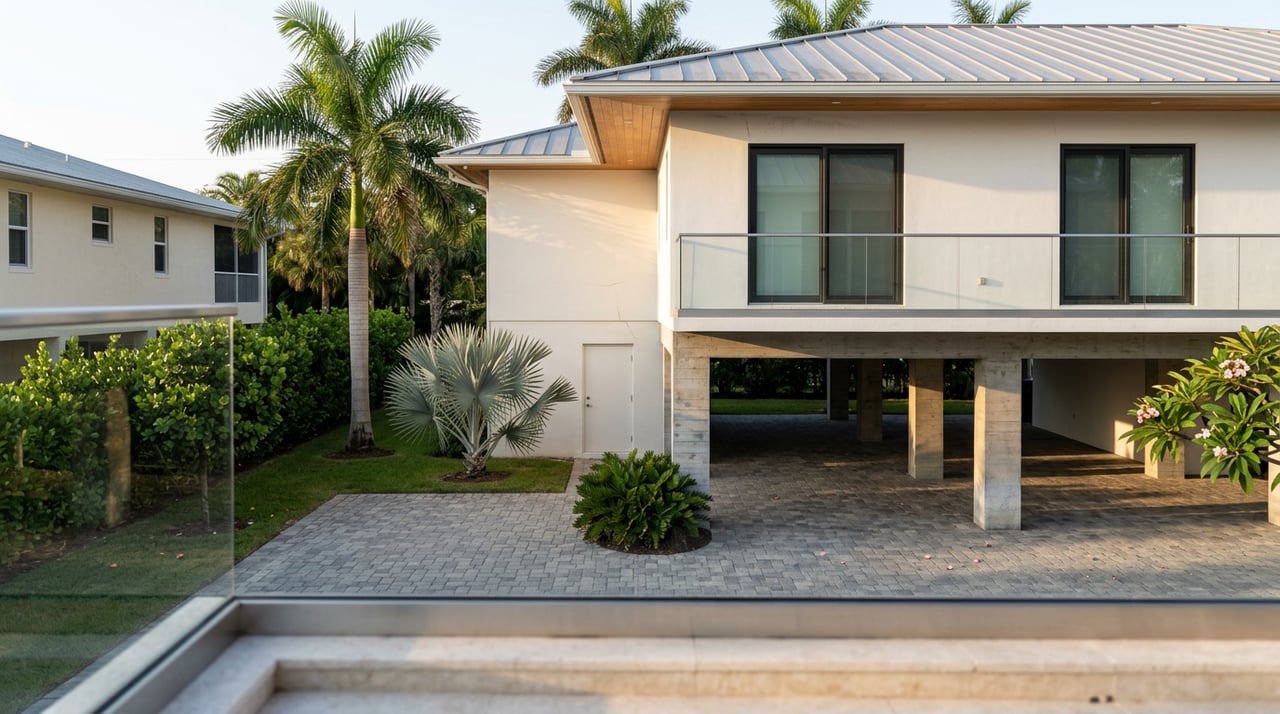
FEMA's Risk Rating 2.0 methodology prices individual properties, not just zones. The zone still determines whether a lender requires flood insurance at all. But the price is now built from distance to the water, the structure's specific elevation relative to Base Flood Elevation, foundation type, and rebuilding cost, among other factors. Two houses in the same AE zone on the same street can carry very different premiums purely because one sits eighteen inches higher or has a different foundation profile.
This is why the scenario at the top of this piece isn't unusual. It's the new normal for how Naples waterfront insurance gets priced, and it means a listing agent who quotes a buyer's insurance cost off the zone letter alone is guessing.
Even Zone X, generally considered the lower-risk category where federally backed lenders typically don't require coverage, isn't risk-free. Historically, something like a fifth to a quarter of NFIP claims nationally have originated in Zone X properties, largely because rainfall and drainage issues don't respect flood zone lines the way storm surge maps do.
If the zone letter isn't the deciding factor, the elevation certificate is. It documents the structure's lowest floor and machinery elevations relative to Base Flood Elevation, and it's the single most concrete way to prove a home is a better insurance risk than an automated map estimate might suggest.
The City of Naples has its own wrinkle worth knowing before you price a listing: local building code requires the finished floor to sit at least one foot above the mapped Base Flood Elevation, not merely at it. So a home in an AE7 zone needs a floor elevation of eight feet or higher to meet the city's standard, and a home in AE9 needs ten feet. That extra foot of freeboard is a Naples-specific requirement, and it's exactly the kind of detail a generic flood-zone explainer written for the whole state of Florida will miss.
Under Risk Rating 2.0, an elevation certificate is technically optional. In practice, it's the negotiating tool that lets a seller counter an automated software estimate with a certified survey. Skip it, and you're letting the insurer's internal mapping model make the case for you, which tends not to favor the seller.
There's also a shelf-life problem. Building code has moved since Hurricane Ian, and again after Milton and Helene, and Florida's 9th Edition Building Code takes effect December 31, 2026. A certificate that's several years old may no longer reflect current standards even if the physical structure hasn't changed. If you're planning to list a waterfront property before year-end, this is the year to get a fresh survey rather than lean on paperwork from 2019 or 2020.
The elevation conversation isn't the same conversation in every neighborhood, because construction eras vary block by block.
| Neighborhood | Typical construction pattern | What it means for sellers |
|---|---|---|
| Port Royal | Skews toward newer builds, often elevated well above the minimum required BFE | A current elevation certificate frequently works in the seller's favor and can be a genuine selling point |
| Aqualane Shores | Mix of rebuilt and older homes on the same canals | Elevation can vary meaningfully door to door, so buyers should request a current certificate rather than assume |
| Old Naples | Significant share of pre-code-era homes | Many sit below current BFE, and buyers often factor in the cost to raise or rebuild as part of their offer |
| The Moorings | Similar older housing stock to Old Naples | Same calculation applies, and renovation history matters for reasons covered below |
Port Royal, Aqualane Shores, and Old Naples all sit inside flood zones because of their proximity to the Gulf and Naples Bay, and none of that removes them from the top of the market. What separates a smooth sale from a renegotiated one is whether the seller can document exactly where the structure sits relative to BFE before a buyer's insurance quote surprises anyone.
There's a second mechanism worth flagging for anyone who has updated a waterfront home rather than sold it as-is. Flood insurance rules generally treat a renovation as a substantial improvement once its cost approaches roughly half the structure's market value, and crossing that line can trigger a requirement to bring the whole building up to current floodplain standards, including elevation.
For older homes in Old Naples or The Moorings, this is exactly the kind of detail that surfaces during due diligence and derails a closing timeline if nobody looked at it beforehand. If a home has had significant work done, pulling the permit history before listing tells you whether that threshold was ever approached, and lets you get ahead of the question rather than answer it under contract.
The City also restricts what can happen below the required flood elevation. Space below Design Flood Elevation is generally limited to parking, storage, and building access, and dry floodproofing isn't permitted on residential structures in V and Coastal A zones. For older homes with finished space at ground level, that's worth understanding before a buyer's inspector raises it first.
Does the flood zone on my listing tell a buyer what their insurance will cost? Not by itself. The zone determines whether insurance is required. The price comes from the property's specific elevation, foundation, and distance to water under Risk Rating 2.0.
My elevation certificate is a few years old. Is that a problem? It might be. Building code has shifted since Hurricane Ian, Milton, and Helene, and the state's 9th Edition Building Code takes effect at the end of this year. A certificate can be functionally outdated even if nothing on the property has physically changed.
Is the new flood map already in effect in Naples? No. The map adopted in February 2024 remains the effective one as of this summer, and the 2026 revision is projected for adoption sometime between August and October, pending federal review. Preliminary data is public now, and buyers' teams are already using it for due diligence even though it hasn't been formally adopted.
Waterfront real estate in Naples has never been about the address alone, and it isn't about the zone letter either. It's about what the structure can actually prove, and that's exactly the kind of groundwork worth doing before a listing goes live rather than after an offer comes in. If you're weighing a sale on the water in Naples or anywhere else across Southwest Florida, Shane "Waterfront" Wilson Team can help you get the documentation right before it becomes a negotiation. Get in Touch.
Florida Keys
A real Florida Keys real estate deal showed how a current wind mitigation inspection and one missing detail (the third nail) dropped wind insurance from $12,000 to $5,… Read more

Florida Keys
Welcome to the debut episode of Loving the Florida Lifestyle with veteran Florida real estate broker Shane "Waterfront" Wilson. Grounded in Simon Sinek’s "Golden Circl… Read more
Decades of waterfront expertise, deep local roots, and a passion for the Florida lifestyle define every client experience. The Shane “Waterfront” Wilson combines extensive real estate knowledge with unmatched insight into the Florida Keys and Southwest Florida markets—helping buyers and sellers navigate every step with confidence and ease.
Get In Touch With Our Team
SHANE "WATERFRONT" WILSON
ADDRESS ISLAMORADA 85960 OVERSEAS HWY STE 4 ISLAMORADA, FL 33036 FORT MYERS 7270-4 COLLEGE PKWY FORT MYERS, FL 33907